When access is revoked, how fast does RAG forget?
Copying documents into a vector index copies their permissions as of that moment. The real test of a permission-aware assistant is not whether it filters, but how long a revoked share or a removed group member keeps reaching answers. This design measures that number, bounds it and alerts on it.
Status: a reference design, not deployed as described. It is written from public platform documentation and describes no organisation’s systems, data or metrics; every example is generic. Every number is cited, derived from a formula on this page, or labelled as an assumption. Try it: the interactive walkthrough steps through a revocation from source to answer.
1. Two people, one question
Two people ask an enterprise assistant the same question. They should not get the same answer. One of them can read the restructuring plan; the other cannot. A retrieval-augmented assistant gets this right on day one if every chunk in its index carries the people and groups allowed to read it, and every query is filtered by the caller.
Day one is the easy day. After it, the source keeps changing. Someone removes a share. A manager takes a leaver out of a group. A site owner breaks inheritance on a folder. Each of those is a revocation, and the index hears about none of them on its own. On the reference platform the documentation says so directly: permission changes in the source appear in search results only after the permission metadata is synchronised into the index [1].
So I measure one number: time-to-revoke, the time from a revocation at the source to the moment the revoked person stops seeing that content in answers. The whole design exists to bound it.
An index is a copy of permissions. Every copy has an age.
It matters now because assistants are leaving pilots for the whole organisation. Fifty pilot users hide revocation lag. An assistant open to everyone turns every stale ACL into a question someone can ask. OWASP names unauthorised access and cross-context leakage from shared vector stores as a risk in its 2025 list for LLM applications [9].
2. Why the obvious answers fail
“We filter by the groups in the user’s token.” A token’s groups claim is a snapshot from when the token was issued. Default access tokens last an hour, and sessions under continuous access evaluation can hold tokens for up to 28 hours [7]. Continuous access evaluation acts on a short list of critical events (an account disabled or deleted, a password reset, MFA enabled, tokens revoked by an administrator, high user risk). A group membership change is not on it, and the documentation says such changes can take up to a day to take effect [7]. The claim also caps out: a JWT carries at most 200 groups before it is replaced by an overage indicator and the app has to ask the directory [6]. Filtering on the token is filtering on yesterday’s org chart.
“The indexer picks up permission changes.” Partly. The reference platform’s SharePoint connector picks up a change on an item with its own unique permissions on the next successful indexer run. A change on a parent (site, library, list or folder) that children inherit is not detected; you must call a resync or reset and run the indexer again, and until you do, the index serves stale ACLs [2]. Inheritance is how most organisations share, so the common case is the undetected one.
“Re-index nightly.” That bounds time-to-revoke at about a day plus the run time. For a leaver, that is exactly the window that matters.
“Check the source for every result.” The most correct answer and the most expensive. It adds a permission call per candidate chunk per query, and ties the assistant’s availability to every source’s API. I use it, but only for a short list of sensitive labels.
3. The design
Eleven components in four zones, plus the person asking. The sources and the directory are authoritative and outside my trust boundary. Everything from the sync service inward is mine and must assume it can be stale. Following zero-trust practice, nothing is trusted for where a request comes from; each query is authorised on its own [11].
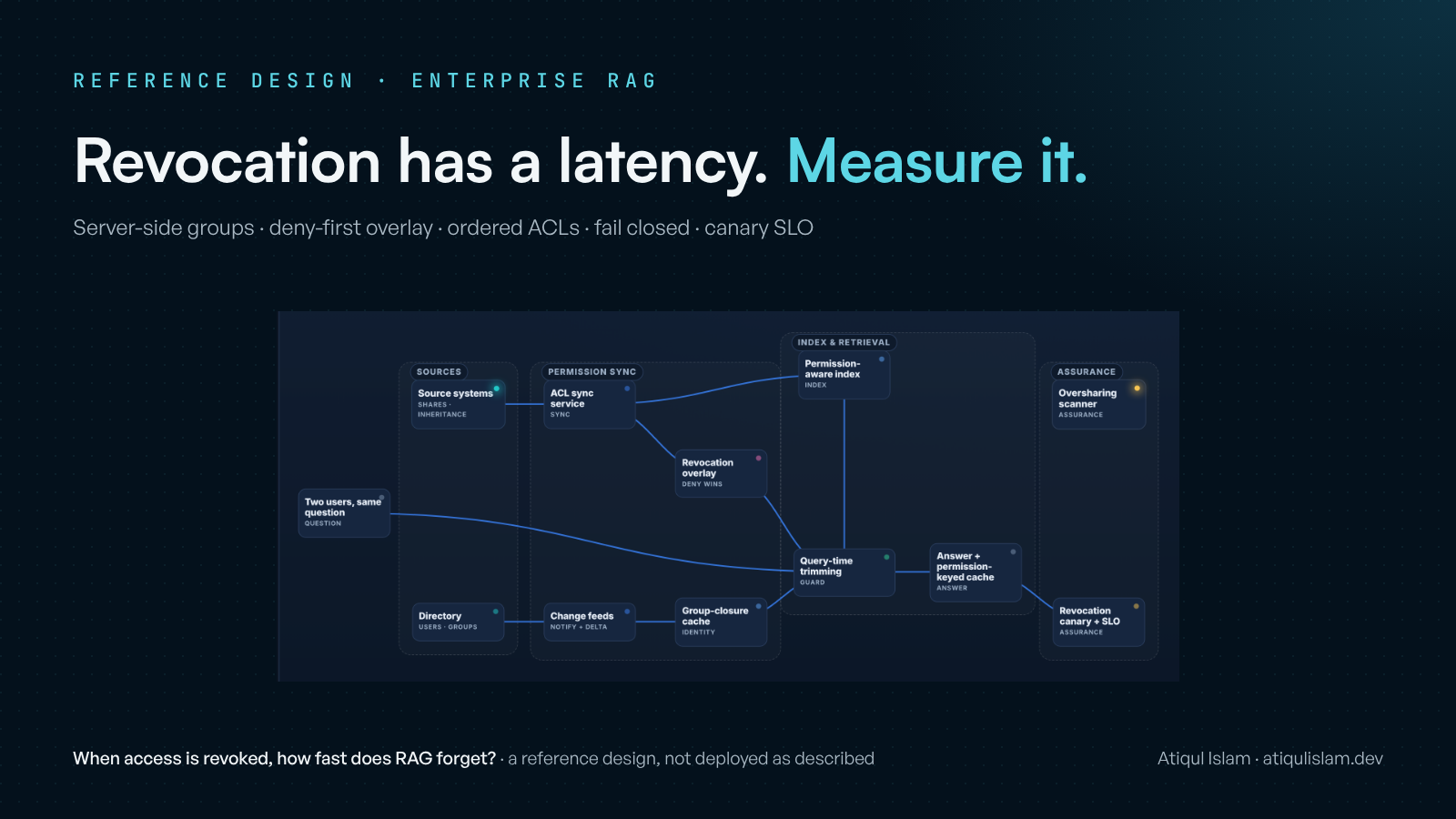
| Zone | Component | What it does |
|---|---|---|
| Sources | Source connectors | One per document store. Emit content changes and permission changes as separate events. |
| Sources | Directory | Owns users, groups and nesting. Reference deployment: Microsoft Entra ID. |
| Sync | Change feeds | A Microsoft Graph subscription on /groups/{id}/members says something changed; a delta query fetches what [4][5]. A scheduled poll runs anyway, because group notification latency is listed as unknown [5]. |
| Sync | ACL sync service | Walks inheritance itself to compute each document’s effective ACL, writes it with an acl_version, and processes idempotently because delta can replay changes [4]. |
| Sync | Revocation overlay | A small deny store. On a revocation it gets (principal, document, expiry) within seconds, before the index is rewritten. Deny wins. |
| Sync | Group-closure cache | Each user’s transitive groups, resolved server-side and refreshed from the feed with a short TTL. Never read from the token. |
| Retrieval | Permission-aware index | Every chunk carries principal IDs in a filterable, non-retrievable field [3], plus doc_id, acl_version and label. ACL fields must be projected onto every chunk, or chunks go unfiltered [1]. |
| Retrieval | Query-time trimming | Builds a search.in filter from the closure [3], runs the query, removes overlay hits, and live-checks high labels. Trimming happens before the prompt is built, never by instructing the model. |
| Retrieval | Answer cache | Keyed by a hash of the caller’s closure and the ACL epoch of the cited documents. A revocation orphans the cached answer. |
| Assurance | Oversharing scanner | Before launch and on a schedule: what in scope is readable by nearly everyone? The SharePoint data access governance reports give a baseline and flag “Everyone except external users” [8]. |
| Assurance | Revocation canary | Shares a synthetic document to a test principal, revokes it on a schedule and queries until it disappears. The elapsed time is time-to-revoke, measured end to end. |
4. A revocation, step by step
- Two users, same question, different evidence. A and B ask about next year’s team structure. Each closure comes from the cache. A’s includes the planning group; B’s does not. A’s answer cites the plan; B’s cites the published org chart.
- A share is revoked and the change reaches the index. The plan’s owner removes A’s direct share. The connector emits a permission event. The sync service writes a deny entry for (A, plan) in seconds, recomputes the plan’s ACL and rewrites every chunk with a new
acl_version. - The answer changes. A asks again. Even if the index write has not landed, the overlay removes the plan’s chunks, and the cached answer misses because the plan’s epoch moved. A gets the org-chart answer.
- A group member is removed. A leaves the planning group. The notification arrives, or the next poll finds it, and A’s closure is replaced. A’s token still lists the group. It no longer matters.
- A sync breaks. No delta poll has succeeded within the staleness budget. Closures are marked stale and retrieval narrows to content everyone in scope may read, with a visible notice. An alert fires.
- The canary measures it. A synthetic document is shared, revoked and probed until it disappears. That run’s time-to-revoke goes into the SLO.
- Before go-live: the oversharing report. The scanner finds a library shared with everyone internally that holds personnel documents. It is excluded until its owner narrows access. Launch waits on high findings, not on all of them.
5. The subtle failure: the new enemy
Google’s Zanzibar paper describes the “new enemy” problem: a user is removed from a folder’s ACL, new documents are then added to the folder, and if the system applies the two changes out of order, the removed user sees the new documents [10]. A RAG index has the same hazard. A content update can re-index a chunk with an ACL read just before the revocation landed, and silently restore access.
The rule that prevents it: ACL and content updates for a document go through one ordered queue, and any ingest carrying an acl_version older than the stored one is rejected. Zanzibar solves the general case with consistency tokens; a per-document version is enough here.
6. Controls and failure modes
| Failure | Detection | Fallback |
|---|---|---|
| Parent-scope change not detected by the connector | Sync walks inheritance itself; nightly source-vs-index ACL diff | Reset the affected documents and re-run (on the reference platform, resync with permissions or reset docs) [2] |
| Notification lost or late | Scheduled delta poll regardless [4] | The poll interval bounds detection |
| Delta token expired | Directory-object tokens last 7 days; 410 Gone means full sync [4] | Alert at 24 hours without a good poll; full resync |
| Subscription expired | Directory subscriptions last under 29 days [5] | Renew at half-life; alert on failure |
| Closure cache stale | Last-good-refresh timestamp | Fail closed to everyone-readable content |
| Overlay unavailable | Health check | Retrieval refuses rather than skipping the deny path |
| Principal the connector cannot express (“Anyone” links, guests, an Entra group nested in a SharePoint group) [2] | Inventory at onboarding | Exclude the content; never treat “unsupported” as “everyone” |
| ACL and content applied out of order | acl_version per chunk | Reject older versions (the new-enemy rule above) [10] |
7. Decisions and trade-offs
Own the ACL sync; use the connector for content. The platform’s native ACL ingestion is attractive: query-time trimming with the user’s token, with nested Entra groups resolved through Graph [1][2]. But it is in preview, which the documentation says carries no SLA and is not recommended for production [1], and it misses inherited changes [2]. So I push principal IDs as plain security-filter fields, the generally available pattern [3], from my own sync. The cost is an inheritance walker I own. The gain is that every stage can be measured and bounded. When native ingestion reaches general availability with inherited-change detection, I would revisit this.
Server-side closure, never token claims. It costs a cache and a feed. It removes the 200-group overage problem [6] and decouples revocation from token lifetime [7].
A deny overlay instead of a synchronous re-index. Putting an index write on the critical path of every revocation is simple, but slow under load. The overlay makes the fast path one key write and lets the index catch up.
Fail closed. When the closure is stale beyond budget, users see less, with a notice. Serving on stale permissions is the failure the design exists to prevent.
Live re-check only for high labels. Checking every candidate against its source multiplies source calls by top-k. A short label list keeps cost proportional to risk.
8. Metrics and SLOs
Time-to-revoke. For a revocation at source time t_r, and the first time t_e after which no answer for the revoked principal cites the document: TTR = t_e − t_r. The canary measures it.
The budget (assumptions to tune, not benchmarks). Without the overlay, worst-case time-to-revoke for a group removal is the sum of the stage delays: TTR_max = P + I + T, where P is the delta poll interval, I the index write-to-visible allowance and T the closure cache TTL. With P = 5 min, I = 1 min and T = 5 min, TTR_max = 5 + 1 + 5 = 11 min. Against a 15-minute target that leaves 4 minutes for directory replication delay, which the documentation does not quantify [4][5]. With the overlay, an item-level revocation seen by the connector skips I and T: time-to-revoke is roughly connector detection plus one overlay write.
| SLO | Formula | Target (assumption) |
|---|---|---|
| Time-to-revoke | p95 of canary TTR over 7 days | ≤ 15 min |
| Stale-ACL leak rate | canary answers citing a revoked document after the deadline ÷ canary probes | 0; any hit pages |
| Sync freshness | now − last successful delta poll | ≤ 2 × P = 10 min |
| Reconciliation drift | documents whose index ACL ≠ source ACL ÷ documents reconciled | 0, reported nightly |
| Exposure ratio (pre-launch) | chunks readable by ≥ 90% of in-scope users ÷ all chunks | A review queue, not a pass mark |
9. Rollout
- Inventory and scan. Run the oversharing baseline [8], list unsupported principal types [2], set the exclusion list.
- Shadow sync. Run the sync and the closure cache beside the existing index; nightly reconciliation only.
- Canaries on. Publish time-to-revoke p95 for two weeks before any user sees an answer.
- Pilot, fail-closed. Page on any stale-ACL leak.
- Widen one source at a time, each with its own canary.
- Re-scan on a cadence: snapshots quarterly, activity reports monthly, as the platform documentation recommends [8].
10. What it does not do
- It does not fix oversharing at the source. If a folder is shared with everyone, the assistant will answer everyone. The scanner finds it; owners fix it.
- It does not make revocation instant. It makes it bounded and measured.
- It does not recall answers already given. Someone who read a document before the revocation read it.
- It does not stop copying. A user can paste what they can read, or screenshot an answer.
- It does not handle embedding inversion or memorisation. It assumes source content never fine-tunes the model [9].
- It does not guess at principals the connector cannot express. That content is excluded.
- It is a reference design, not deployed as described. The budget figures are assumptions for the canary to replace with measurements.
Closing
Every permission-aware RAG system filters. The difference is whether anyone knows how old the permissions it filters on are. Resolve groups on the server, put a deny overlay in front of the index, keep ACL and content in order, fail closed when the copy is too old, and let a canary tell you the number. Then the answer to “how fast does RAG forget?” is a measured p95, not a hope.
Sources
- Document-level access control in Azure AI Search, Microsoft Learn (updated 17 Sep 2026)
- SharePoint ACL ingestion in Azure AI Search (preview), Microsoft Learn (updated 17 Sep 2026)
- Security filters for trimming results in Azure AI Search, Microsoft Learn (updated 24 Aug 2026)
- Use delta query to track changes in Microsoft Graph data, Microsoft Learn
- Microsoft Graph change notifications overview, Microsoft Learn
- Configure group claims and app roles in tokens, Microsoft Learn
- Continuous access evaluation, Microsoft Learn (updated 8 Apr 2026)
- Data access governance reports for SharePoint sites, Microsoft Learn (updated 30 Jul 2026)
- LLM08:2025 Vector and Embedding Weaknesses, OWASP GenAI Security Project
- Zanzibar: Google’s Consistent, Global Authorization System, Pang et al., USENIX ATC 2019
- SP 800-207, Zero Trust Architecture, NIST, 2020